Khashaba: Nagraj Manjule’s Olympic Wrestler Biopic
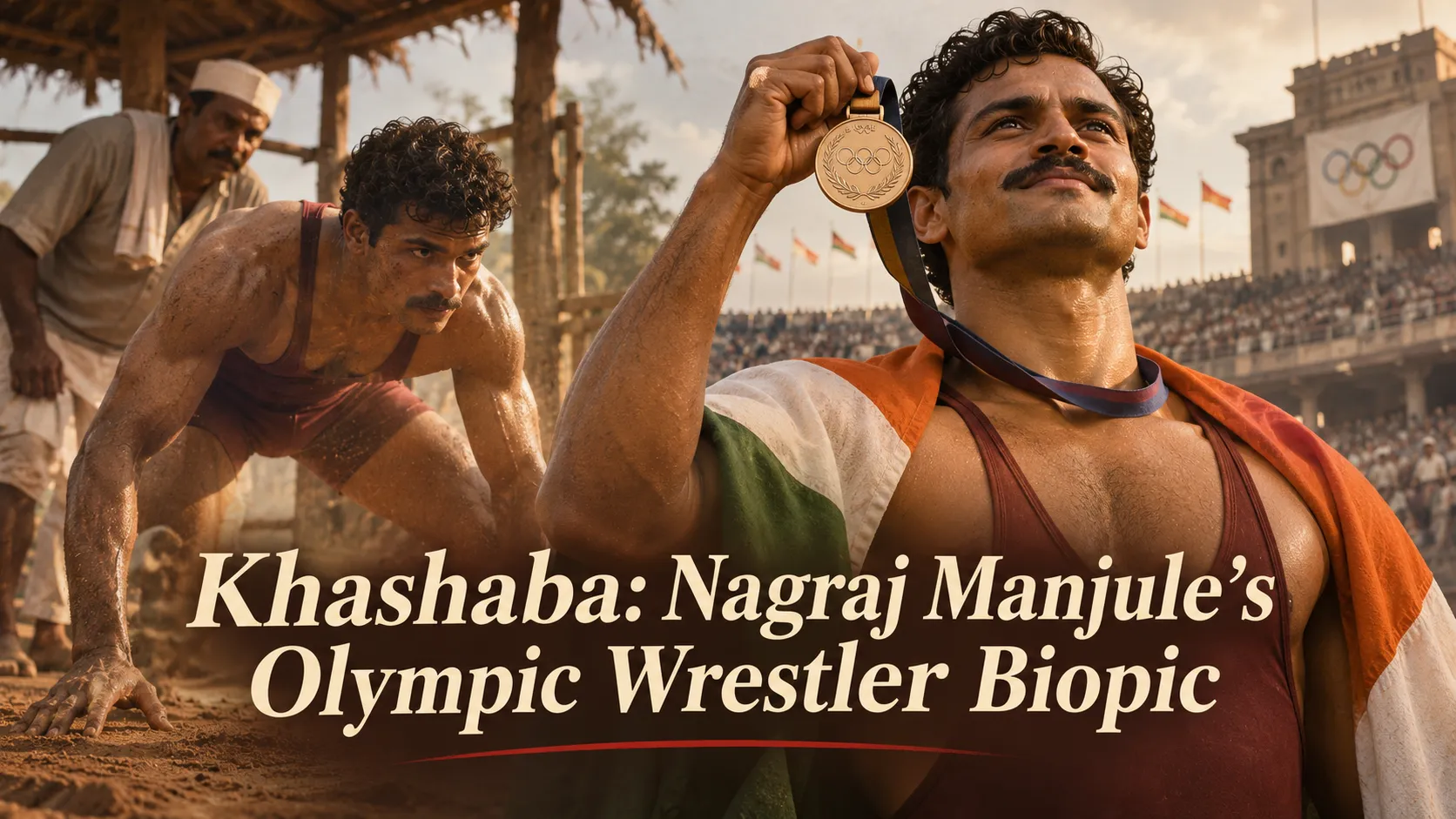
One of the most remarkable events in the history of Indian sports is going to be portrayed on the big screen. It is the forthcoming Marathi film, Khashaba, directed by Nagraj Manjule.
Jadhav became the first individual Olympic medalist from independent India with his bronze medal win in the 1952 Helsinki Olympics.
The film is produced by Jio Studios and Aatpat Productions. It is going to be released theatrically across the world on January 1, 2027.
The film’s first teaser focuses on the hardships of rural Maharashtra and International level wrestling competitions.
While the main cast has not been announced, the film’s supporting cast includes well-known actors. The actor playing Jadhav has not been announced.
The movie is about a person from a rural area of Maharashtra who wants to go beyond and is determined to achieve something great at the international level.
Jadhav comes from a lower class family. He works hard and practices wrestling.
The movie is about the sacrifices that sports people have to make to balance their family responsibilities and requirements of sports discipline.
The film showcases the combination of rural traditional and modern international sports.
At the end of the teaser, audiences are left with the Helsinki Olympics.
The directors of the movie have not released the complete screenplay of the film in a chronological order.
Thus, the rest of the movie and the conversations and conflicts shown in the teaser should be regarded as artistic liberties unless there is evidence to the contrary.
Born in 1926 in Maharashtra, Khashaba Dadasaheb Jadhav’s fame is owed to his interest and participation in wrestling at a young age, which was strengthened by the guidance of his father who was associated with the sport.
Prior to his participation in the Olympics twice, he represented India in the 1948 London Olympics.
In the 1952 Helsinki Olympics, Jadhav won the freestyle wrestling bantamweight division, bringing home the third medal for the country.
Before Jadhav’s accomplishment, independent India won medals in Olympic field hockey events, where the team won gold in 1928 and 1932; and 1948; and 1952.
Apart from winning the first medal for India in individual event in the Olympic Games, Jadhav became the second individual wrestler from the country to win a medal after K.D. (Babu) Singh, who won a silver in the 1950 Commonwealth Games.
Readers seeking movie downloads must distinguish between terminology generally used for online entertainment and legitimate distribution of the film. The central and confirmed topic of the production remains the achievement of the historical athlete.
Nagraj Manjule directs and co-writes the film. Apart from screenwriting, directing, and other related duties, he is internationally recognized as a filmmaker for social inequalities in Indian society through his Marathi films Fandry and Sairat. His Jhund draws the same parallels as Khashaba.
Returns to a sports-related, historical theme associated with Maharashtra, is evident in Manjule’s latest project.
Gargee Kulkarni shares the screenplay and production responsibilities.
Jio Studios and Aatpat Productions are the main production houses for the project, with Jyoti Deshpande also a part of the producer team.
Harshvardhan Waghdhare handles the camera, while Kutub Inamdar edits.
The filmmakers are yet to announce the film’s final running time.
Jitendra Joshi, Mahesh Manjrekar, Girish Kulkarni, Chhaya Kadam, Vaibhav Mangale, and Om Bhutkar star in the film.
Other supporting performers also include Gargee Kulkarni.
The teaser for the film intentionally blurred the identity of the actor playing Khashaba Jadhav.
Because of this, no performer can be named the protagonist without an official statement.
Ajay-Atul, the music directors responsible for the soundtrack of Sairat, have composed the film score.
It is expected that the score will complement the emotional and sporting aspects of the film.
The teaser provides a sample of the score with powerful music and images of demanding physical training.
The names and backstories of the supporting characters are also yet to be released.
Traditional wrestling is a sporting tradition in the culture of Maharashtra.
Athletes work out in akharas and develop strength, will, and skill.
International wrestling was dominated by the Soviet Union and other Eastern Bloc countries, and Jadhav’s performance at the Olympics helped showcase that Indian wrestlers have what it takes to thrive on the international stage as well. On the other hand, it shows how financial means can limit and obstruct an athlete’s journey.
The location of the film in rural Maharashtra shows where an athlete has to look to really develop the tenacity and determination to surmount the obstacles in their way.
What is shown in the film should not always be conflated with actual things that occurred in history.
Biographical films tend to include documented events and facts as well as fictionalized and dramatized sequences.
From a review of search analytics, terms related to movies mod apk showed no relation to the film’s authorized release dates in theaters or over digital streaming platforms.
What can be confirmed is that the film will premiere theatrically this year. As for the exact release date, that is up in the air.
Khashaba is scheduled to hit theaters worldwide on January 1, 2027.
The release date was confirmed with the release of the teaser on July 2, 2026.
The promotional campaign has established the historical subject, director, some of the production companies, supporting cast, and the principal creative team.
The identity of the leading actor is still unknown, as is the final running time and the date of its release on a streaming service.
The film’s main attraction is its depiction of an important moment in Indian sporting history.
With Nagraj Manjule as the director and Ajay-Atul composing the music, Khashaba is a film centered around determination and athletic accomplishment, and a wrestler whose Olympic bronze medal helped establish a national legacy, and sporting heritage of India.